
How online slots work: paylines, RTP and volatility
Slots carry most of the weight in our comparison, so it helps to know what the columns are describing. This is the mechanics — how a spin is decided, what the percentages mean, and which rules apply specifically in Great Britain.
What a spin actually is
A slot is a random number generator with pictures on top. The reels you watch are a presentation layer: the outcome is chosen the instant you press the button, and the animation exists to show you a result that already exists. That single fact disposes of most slot folklore, including the belief that a machine warms up, cools down or owes you anything after a bad run.
-
You set the stake
Coin value and lines or ways in play. In Great Britain, statutory limits cap online slot stakes at £5 a spin, and £2 a spin for players aged 18 to 24.
-
The generator picks positions
Numbers are mapped to reel stops. Each spin is independent of the last, which is why no sequence of results predicts the next one.
-
Symbols land and are read
The game checks the landed grid against its paytable and any feature triggers, then settles the balance. The whole thing is decided before the reels stop moving.
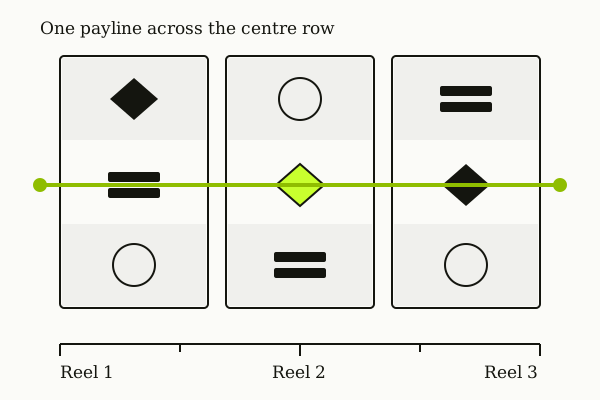
Paylines, ways and clusters
A payline is a fixed pattern across the grid that pays when matching symbols land on it, traditionally left to right. Classic games ran one line; modern ones may run dozens, and the stake is spread across all of them, which is why a twenty-line game at ten pence a line costs two pounds a spin.
Two other systems are common. "Ways" games drop the fixed pattern and pay for matching symbols in any position on consecutive reels, so the number of combinations changes from spin to spin. Cluster games ignore reels altogether and pay when enough matching symbols touch, usually clearing the winners and dropping new symbols into the gaps. None of the three is inherently more generous — the maths is set by the paytable, not the shape of the win.
RTP: what the percentage means, and what it doesn't
Return to player is the share of all stakes a game is designed to pay back across its lifetime — a figure derived from millions of simulated spins, not a forecast for your session. A game published at 96 per cent keeps four pence of every pound in the long run, and can still take everything you put in this evening or pay several times it.
Two practical points. The figure sits in the game's own information panel, usually behind the "i" button, and it is the only place worth reading it. And the same title can be supplied at more than one RTP setting, so the number in front of you is the one that counts, not the one quoted in an article about the game elsewhere.
Volatility, in plain terms
- Low volatility: frequent small returns, a slower curve, a session that lasts longer for the same stake.
- Medium: the middle ground most mainstream titles aim for.
- High volatility: long dry spells punctuated by larger hits, and a bankroll that can vanish quickly. Higher variance is not a higher return — RTP can be identical.
The rules that apply to slots in Great Britain
Games offered by British-licensed operators are built to a stricter specification than the same brands elsewhere, and the differences are noticeable once you know to look.
- A slot spin cannot complete faster than 2.5 seconds, and features that speed up play are not permitted.
- Autoplay is banned, so each spin needs a deliberate action.
- Sound and animation cannot celebrate a return smaller than the stake as though it were a win.
- Games must show elapsed time and total spend during a session.
- Every licensed operator is signed up to GAMSTOP, and deposit limits are available in account settings.
What this means when you choose a site
Because the game maths belongs to the studio rather than the casino, the site you pick changes almost nothing about how a given slot behaves. What it changes is which studios you can reach, how quickly you can find a title, whether a live-dealer room is there when you want a break from reels, and how well the tools for staying in control are put in front of you.
That is precisely what the columns in our comparison table measure. If you want the shorter version, the questions page covers wagering terms, live tables and licence checks in the same plain register.
Before you spin
- Set a deposit limit first, in account settings, before the first game loads.
- Open the game information panel and read the RTP and volatility note.
- Decide the session length as well as the spend, and treat both as fixed.
- Never chase a loss — the next spin has no memory of the last one.
18+ only. This page is educational and describes how slot games are built; it is not advice to gamble and not a strategy. No system, staking pattern or choice of game changes the mathematics of a random number generator. Gambling can be addictive and is not a way to make money — free support is available from GamCare, GambleAware and GAMSTOP.
 GAMSTOP
 GamCare
 GambleAware
 Gambling Commission